
2026 Federal Budget
Implications for Capital, Structure & Long-Term Decision Making
Core Themes
- Erosion of policy credibility → retrospective-style changes, reliance on grandfathering
- Capital disincentivised → higher friction on risk-taking and long-duration assets
- Shift toward income over growth → structural bias to yield over capital appreciation
- Consumption over accumulation → reduced incentives to defer, save, and invest
- Redistributive tilt → intergenerational and class-based policy framing
- Expansionary fiscal stance → structurally inflationary bias
- Grandfathering critical → outcomes depend heavily on timing and asset base
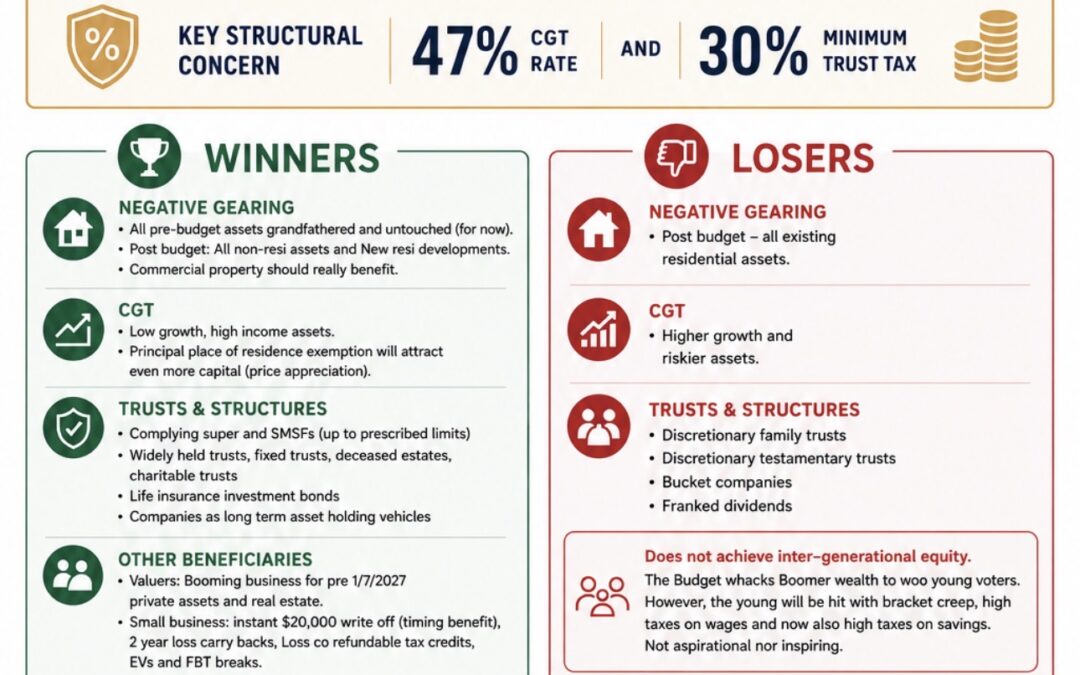
Key Structural Concern
- 30% minimum tax on trusts
- 47% top tax rate on capital gains, with a 30% minimum tax rate
- Double taxation risk → corporate profits taxed at company level + constrained extraction pathways
Winners
Negative Gearing
- Pre-budget assets fully grandfathered
- Post-budget: new residential + all non-residential assets remain eligible
- Commercial property → likely relative beneficiary
CGT Regime
- Favours low-growth / high-yield assets
- Principal Place of Residence (PPOR) → increased capital allocation → upward price pressure
Structures
- Complying super / SMSFs (within caps)
- Widely held & fixed trusts
- Deceased estates & charities
- Life insurance / investment bonds
- Companies as long-term holding vehicles
Secondary Beneficiaries
- Valuers → demand surge pre–1 July 2027 (cost base resets)
- Small business
- $20k instant asset write-off (timing benefit)
- 2-year loss carry-back
- refundable loss credits
- EV / FBT concessions
Losers
Negative Gearing
- Post-budget existing residential property → materially less attractive
Capital Gains
- Higher-growth / higher-risk assets → penalised
Trust Structures
- Discretionary family trusts
- Testamentary discretionary trusts
- Bucket company strategies
- Franked dividend streaming
Intergenerational Reality
- Policy framed as targeting “established wealth”
- In practice:
- Younger cohorts face bracket creep + wage taxation
- Now also higher tax on savings and investment returns
Outcome:
→ Weakens aspiration, capital formation, and long-term ownership culture
Action Points
- Valuations before 1 July 2027 → reset CGT cost bases
- Revisit trust distributions → shift toward fees, salaries, retained structures
- Structure review → migration toward companies, bonds, compliant vehicles
- Asset decisions → assess crystallisation vs deferral of embedded gains
- Advocacy → engage on policy credibility and investment incentives
What Comes Next?
- Extension of tax base toward:
- Principal residence (PPOR)?
- Inheritance / death taxes?
Closing Observation
This Budget marks a structural shift in how capital is treated in Australia:
From encouraging accumulation and risk-taking
→ toward managing distribution and stability
The long-term consequence will depend not on the headline rates,
but on how capital adapts through structure and behaviour.
Should you wish to discuss these matters, and how they may impact you, please do not hesitate to contact us.
#Budget #CGT #Trusts #NegativeGearing #CapitalAllocation #Structuring #PolicyRisk